Physical Address
304 North Cardinal St.
Dorchester Center, MA 02124
Physical Address
304 North Cardinal St.
Dorchester Center, MA 02124
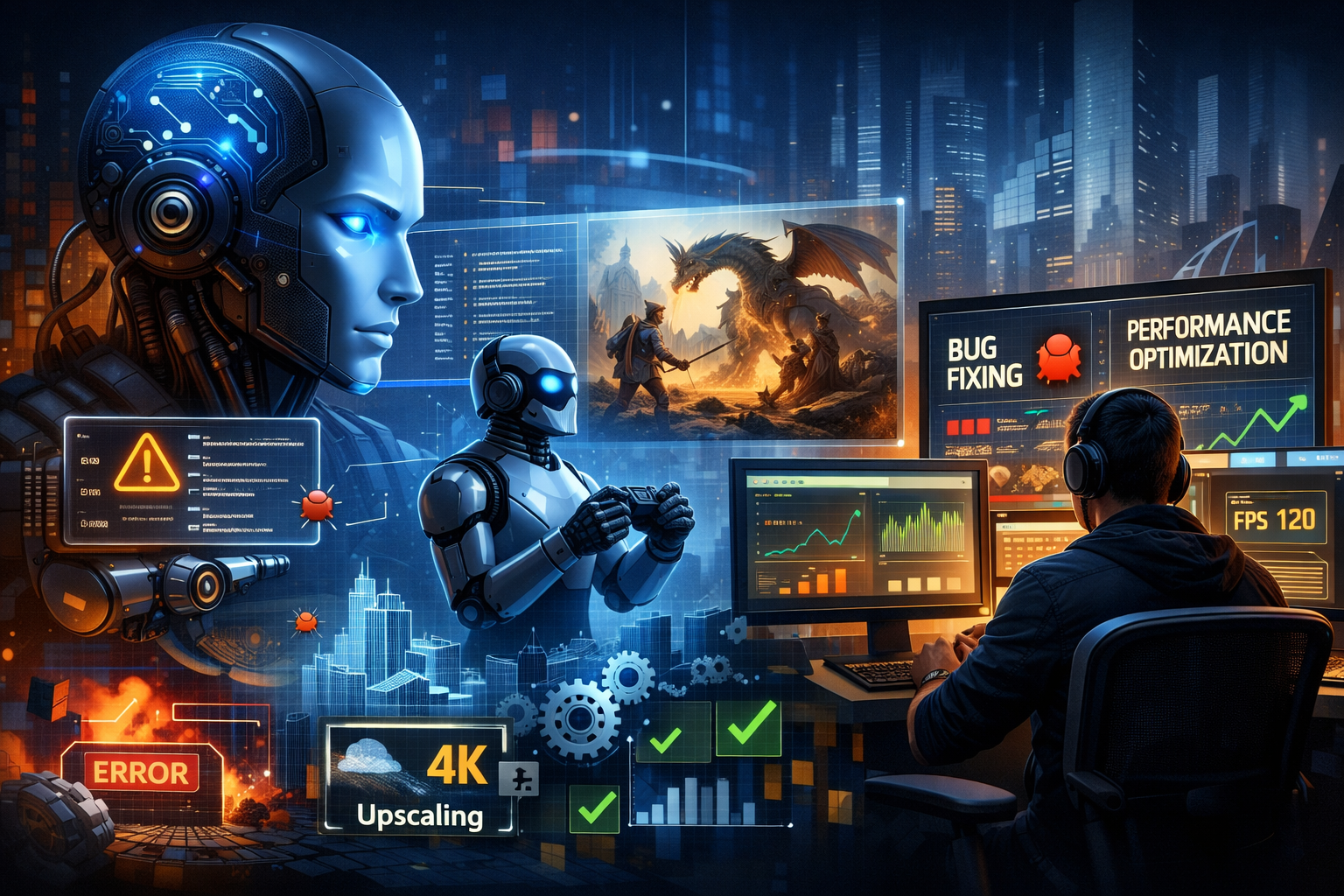
The scope of modern video games is staggering. We’ve moved from linear, single-player experiences to massive, persistent open worlds with thousands of interacting systems. While this complexity allows for unprecedented immersion, it also introduces a significant problem: the sheer volume of code required to run these simulations makes bugs inevitable.
For years, the industry standard for dealing with this has been brute force. Studios hire armies of QA testers to play through the game repeatedly, hoping to catch errors before launch. But as recent high-profile “buggy launches” have shown, human testing can no longer keep pace with the scale of modern development.
This is where AI in game development is shifting from a creative tool like Astrocade for NPC behavior to a critical infrastructural necessity. Artificial intelligence is now capable of diving into the engine itself to detect bugs, predict crashes, and optimize frame rates, before a human developer even knows a problem exists.
To understand why AI is necessary, we have to look at the limitations of the current pipeline. Traditional Quality Assurance (QA) relies heavily on manual labor. Testers play through levels, try to break the game, and log reports. While essential, this process has hard limits:
The industry needs a solution that scales with complexity. It needs automation that is intelligent enough to understand context, not just run scripts.
AI-driven testing tools are revolutionizing how studios approach quality assurance. Instead of replacing human testers, these tools act as a force multiplier, handling the repetitive drudgery so humans can focus on qualitative feedback.
One of the most exciting applications of machine learning in gaming is the use of automated bots for playtesting. Unlike simple scripts that walk a character from Point A to Point B, these bots use reinforcement learning to “learn” the game.
They can play thousands of instances of the game simultaneously at speeds far exceeding human capability. These bots can be trained to behave like different types of players: explorers who hug every wall (perfect for finding collision errors), speedrunners who skip dialogue, or completionists who interact with every object.
AI bots can simulate thousands of hours of gameplay in a single night, identifying soft-locks and collision issues that might take human testers weeks to stumble upon. Platforms likeAstrocade demonstrate this in action by using AI agents to rigorously test and optimize community-created games during the generation process, ensuring smooth, bug-free experiences from the start such as the polished tower defense mechanics in Seed Defenders or the seamless platforming in Stickman Anchor.
AI doesn’t just play the game; it reads it. Advanced static analysis tools use AI to scan code repositories as developers write. These tools are trained on vast datasets of code to recognize patterns that typically lead to errors.
Ubisoft, for example, developed a tool called “Commit Assistant” (now known as Clever-Commit). By analyzing the studio’s history of bugs and fixes, the AI can flag a new piece of code that looks similar to a past error. It alerts the programmer immediately, allowing them to fix the bug before the code is even compiled. This shifts the workflow from reactive bug fixing to proactive bug prevention.
Crashes are the bane of any launch. AI tools can now analyze telemetry data from testing sessions to predict stability issues. By correlating memory usage, CPU load, and in-game events, machine learning algorithms can predict where a crash is most likely to occur, even if it hasn’t happened yet. This allows engineers to reinforce stability in specific areas of the game without wasting time optimizing stable sections.
Beyond fixing what’s broken, AI is redefining how games run. Performance optimization has traditionally been a manual process of downgrading assets, baking lighting, and aggressive level-of-detail (LOD) management. Today, AI handles much of this heavy lifting in real-time.
Perhaps the most consumer-facing example of automated game performance optimization is intelligent upscaling, popularized by NVIDIA’s Deep Learning Super Sampling (DLSS) and AMD’s FidelityFX Super Resolution (FSR).
Traditionally, running a game at 4K resolution requires the GPU to render every single pixel natively, which is incredibly taxing. AI upscaling changes this equation. The game renders at a lower internal resolution (like 1080p), and a neural network reconstructs the image to look like 4K.
The AI “hallucinates” the missing details based on training data from high-resolution images. The result is a game that looks sharp but runs with significantly higher frame rates because the hardware is doing less work.
AI is also optimizing how game engines manage memory and assets. In a massive open world, keeping everything loaded in memory is impossible. Traditional engines use distance-based culling to decide what to load.
AI game maker system can be far more dynamic. They can analyze player behavior to predict where the player is going next. If the AI predicts the player is about to turn a corner or enter a vehicle, it can prioritize loading those specific assets while aggressively dumping unneeded data from memory. This leads to smoother traversal and fewer “pop-in” textures, all without manual scripting from level designers.
As we look toward the next generation of game engines, the concept of “self-healing code” is moving from science fiction to possibility. We are approaching a point where an engine might be able to detect a minor error like a texture failing to load or a script hanging and automatically apply a temporary patch or workaround without crashing the game.
This shift represents a fundamental change in development philosophy. We are moving away from “bug fixing” (reactive) to “bug prevention” and “system resilience” (proactive).
For studio managers and CTOs, the value proposition is clear: efficiency and stability.
The integration of AI in game development is not an “all-or-nothing” proposition. It starts with small steps.
The complexity of games will only increase. Manual processes cannot scale to meet this challenge. AI is the tool that will allow developers to build the massive, immersive worlds of the future without being crushed under the weight of their own code.
