Physical Address
304 North Cardinal St.
Dorchester Center, MA 02124
Physical Address
304 North Cardinal St.
Dorchester Center, MA 02124

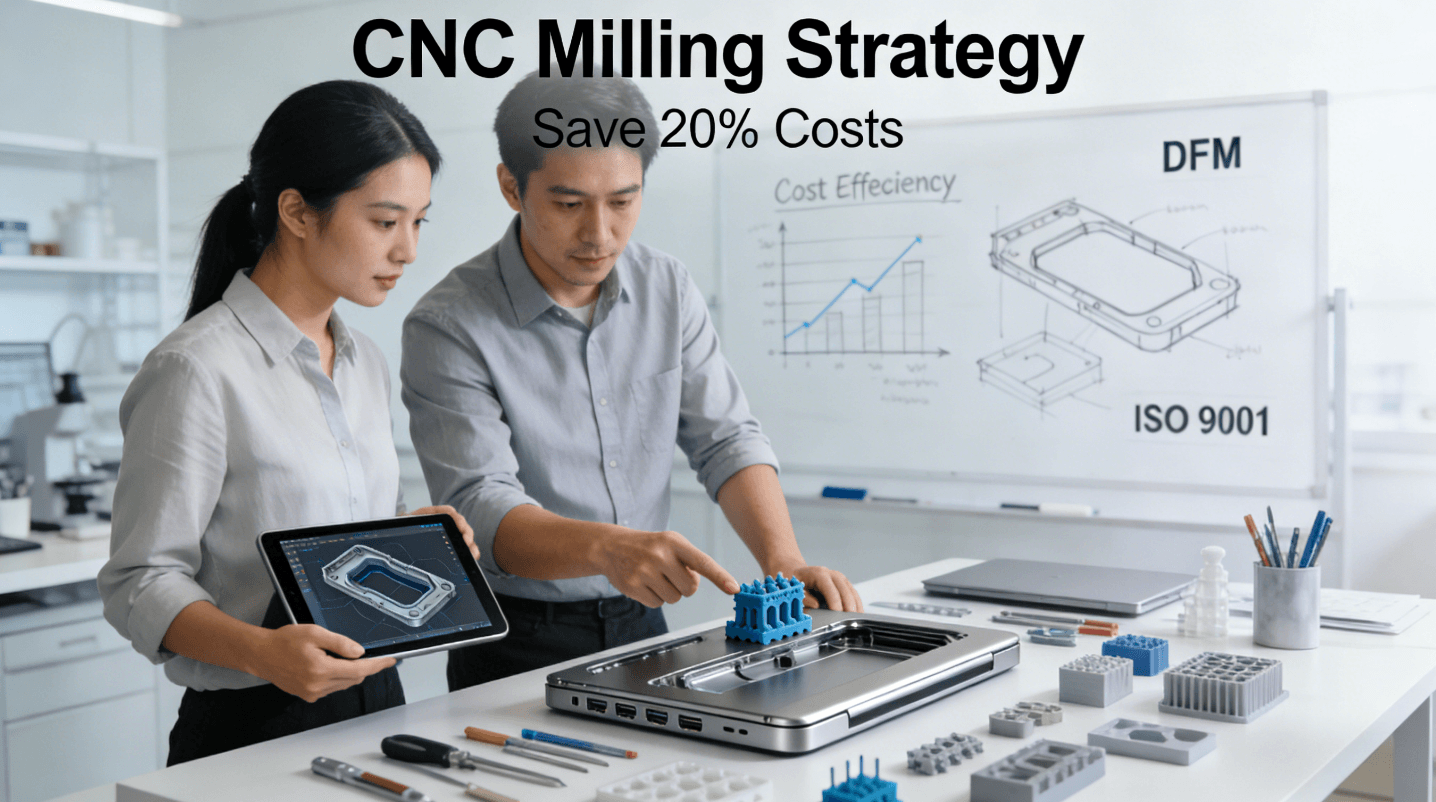
In the modern industrial design landscape, where minimalist aesthetics must coexist with high performance, designers frequently face a critical challenge. The visual prototypes that look stunning in renderings often fail to translate cost-effectively into mass production, struggling to maintain their intended form and finish.
The root cause lies in a knowledge gap between design intent and manufacturing reality. A lack of understanding regarding CNC milling type selection and process boundaries leads to designs that are difficult or prohibitively expensive to machine, often failing due to tolerance stack-ups or unsuitable surface finishes. This article, from a precision manufacturing perspective, outlines how strategic milling strategy selection and rigorous cost analysis can bridge this gap, achieving both manufacturing excellence and design fidelity.
Industrial design transcends sketches to become tangible through precision CNC milling. The surface texture, geometric fidelity, and seamless assembly of a product are directly dictated by the milling process. Spindle speeds, toolpaths, and machine kinematics control everything from the clarity of a polished bevel to the consistency of a matte texture across thousands of parts. For instance, achieving the perfect, reflection-free brushed finish on a laptop chassis or the flawless continuity of a complex organic curve on a wearable device requires the dynamic tool orientation control of multi-axis machining. Companies leverage advanced 5-axis technology to accurately translate intricate design surfaces from digital models into physical reality, ensuring the visual and tactile quality meets the original design vision.
The journey of a cutting tool across the workpiece, defined by its toolpath, is the primary sculptor of surface quality. For high-gloss finishes, optimized toolpaths with minimal step-over distances and consistent engagement angles are critical to eliminate visible cusps or tool marks. Conversely, specific toolpath strategies can be employed to create uniform, designed textures. Any vibration or deflection during cutting, often a result of suboptimal toolpath planning, will manifest as surface irregularities, directly compromising the industrial design aesthetics.
Complex geometries featuring undercuts, deep cavities, or compound curves are impossible to machine accurately in a single setup on traditional 3-axis machines. This forces multiple re-fixturing, introducing errors and visible seams. 5-axis CNC machining solves this by allowing the cutting tool to approach the workpiece from any angle, enabling the complete machining of sophisticated shapes in one clamping. This single-setup capability is paramount for maintaining the geometric integrity and seamless appearance of modern industrial designs, from aerodynamic automotive components to ergonomic medical device housings.
Tight geometric tolerances are the invisible framework that ensures aesthetic perfection. They control the alignment of split lines, the flush fit of buttons, and the precise gap between assembled parts. Precision CNC milling held to standards like ISO 2768-m ensures that every produced part adheres to these strict dimensional boundaries. Without this consistency, even minor variations can lead to perceived poor quality, such as uneven gaps or misaligned features, fundamentally undermining the product’s premium design intent.
Selecting the correct CNC milling type is the first and most crucial step in balancing aesthetic goals with prototyping efficiency and cost. The choice between 3-axis, 4-axis, and 5-axis milling dictates not only what geometries are possible but also the required number of setups, which directly impacts lead time, cost, and potential for error accumulation. A strategic selection aligns the prototype’s complexity with the most economically viable process, ensuring the visual prototype accurately represents the final manufacturable design without unnecessary expense.
3-axis CNC milling is the workhorse for parts that are primarily prismatic, where all features can be accessed from a top-down approach. It is highly efficient and cost-effective for machining blocks, plates, and components with simple contours. For visual prototyping, it is perfectly suited for enclosures, brackets, and parts where the primary surfaces are planar. However, its limitation lies in accessing features on the sides or at complex angles, which would require manual re-fixturing, potentially introducing errors and affecting the cosmotic consistency of the prototype.
The addition of a rotary axis (4th axis) allows the workpiece to spin, enabling machining on multiple sides in a single setup. This is invaluable for prototypes featuring cylindrical elements or circumferential details, such as grooves, gears, or engravings around a diameter. 4-axis machining significantly reduces handling time compared to multiple 3-axis setups, improving accuracy for features that need to be indexed around a central axis. It bridges the gap between simple and highly complex parts, offering a more efficient path for prototypes with rotational symmetry.
For prototypes with complex contours, free-form surfaces, or features requiring tool access from multiple angles, 5-axis simultaneous machining is indispensable. It allows the cutting tool to maintain an optimal orientation relative to the surface, enabling the creation of organic shapes, deep cavities, and undercuts in one setup. This not only achieves unparalleled geometric accuracy but also allows for the use of shorter, more rigid tools, resulting in better surface finishes on challenging geometries. For designers pushing the boundaries of form, understanding when to leverage 5-axis capabilities is key to feasible visual prototyping. Engineers should master the limitations of different processes early on. For a detailed comparison and cost trade-offs on selecting the optimal strategy, the guide on custom CNC milling services provides comprehensive insights.
A thorough CNC milling cost analysis is not merely a final calculation but a powerful tool for design optimization and budget control. Cost drivers extend beyond material choice to include material removal volume, machining time (influenced by part complexity), tooling requirements, and the number of required setups. By analyzing these factors during the design phase, teams can make informed decisions that dramatically reduce waste and expense. Incorporating Design for Manufacturability (DFM) feedback, such as standardizing internal corner radii to match common end mill sizes, can simplify toolpaths and reduce cycle times, leading to a more favorable CNC milling quote.
ISO 9001 certified machining provides the systemic foundation for manufacturing excellence and product consistency. It is not merely a certificate but a framework for a Quality Management System (QMS) that ensures every process — from order review and material procurement to production and inspection — is documented, controlled, and continuously improved. For designers and brands, this certification means that every production batch will match the quality of the approved prototype. Manufacturers holding additional, sector-specific certifications like IATF 16949 (automotive) and AS9100D (aerospace) demonstrate an even higher commitment to traceability, risk management, and defect prevention in highly regulated industries.
The core value of a certified machining process is repeatability. A robust QMS ensures that the parameters, tooling, inspection methods, and operator instructions that successfully produced the first visual prototype are meticulously documented and replicated for production runs of 10 or 10,000 units. This systematic approach eliminates variability, ensuring that the dimensional accuracy and surface finish that met aesthetic and functional requirements in the prototype are guaranteed in every single production part, which is the true hallmark of manufacturing excellence.
In regulated industries, risk mitigation and product traceability are non-negotiable. Certifications like AS9100D mandate rigorous control over suppliers, material certifications, and production history. Every critical component can be traced back to its source material, the machine that produced it, and the operator who performed the inspection. This closed-loop system not only prevents non-conforming parts from reaching the customer but also allows for rapid and effective corrective action if an issue is ever identified, protecting both the manufacturer and the end client.
Beyond adherence to standards, a true quality culture fostered by ISO 9001 focuses on continuous improvement. Certified manufacturers are required to monitor processes, analyze non-conformities, and implement corrective actions. This proactive stance means the manufacturing system is not static but evolves to become more efficient, reliable, and cost-effective over time. Partnering with such a supplier means your projects benefit from an ever-optimizing system dedicated to achieving the highest levels of performance and reliability.
The applications of CNC milling are the engine of innovation across modern industry, enabling the physical realization of groundbreaking designs. From the ultra-thin, unibody frames of consumer electronics to the lightweight, structural brackets in aerospace, milling technology turns advanced concepts into functional components. Innovations in materials, such as high-strength aluminum alloys or biocompatible polymers like PEEK, continuously drive the evolution of milling applications, demanding new tooling strategies and machining parameters to achieve the necessary precision and surface quality.
In consumer electronics, CNC milling is critical for creating the precise, seamless enclosures that define premium devices. The process machines aluminum or stainless steel into complex, thin-walled structures with tight tolerances for perfect assembly. The ability to achieve a variety of high-quality surface finishes — from anodized colors to precise textured patterns — directly from the milled part is essential for brand differentiation. Furthermore, milling is used to create intricate internal chassis and heat sinks that manage thermal performance in increasingly compact form factors.
The automotive and aerospace sectors rely on milling for high-performance components where strength-to-weight ratio is paramount. 5-axis CNC machining produces turbine blades with complex airfoil geometries, engine blocks with optimized coolant channels, and structural aircraft components with topological optimization. The process ensures these safety-critical parts meet extreme standards for dimensional accuracy and material integrity. Compliance with industry and environmental regulations is also essential; for example, material selection must adhere to standards like the EU RoHS Directive on hazardous substances to ensure global market access.
Medical device manufacturing represents one of the most demanding CNC milling applications. It requires machining biocompatible materials like titanium or surgical-grade stainless steel into complex, patient-specific implants (e.g., spinal cages, joint replacements) and precise surgical instruments. The tolerances are exceptionally tight, often in the micron range, and surface finishes must prevent bacterial adhesion and facilitate osseointegration. The certified machining processes in this field underscore the life-critical importance of precision, cleanliness, and full traceability.
Selecting the right CNC milling supplier is a strategic decision that impacts product quality, cost, and time-to-market. A reliable partner offers more than just machines; they provide engineering partnership and manufacturing expertise. Key evaluation criteria include their technical capability portfolio (3-axis to 5-axis), quality certifications, online collaboration tools for instant quoting and DFM feedback, and proven experience with similar projects. The ideal supplier acts as an extension of your team, ensuring a seamless transition from visual prototyping to scaled production.
Exceptional industrial products are born from the deep fusion of design inspiration and precision manufacturing technology. By mastering the principles of strategic CNC milling type selection and applying rigorous cost analysis from the earliest stages, design teams can protect the visual core of their work while ensuring commercial viability. This disciplined approach, supported by a partnership with a certified machining expert, transforms ambitious designs into manufacturable, high-quality, and successful products.
Q1: How does the complexity of a design affect the final CNC Milling Quote?
A: Design complexity directly dictates the required machine type (e.g., 5-axis vs. 3-axis) and total machining time. Features like deep cavities, thin walls, or undercuts need specialized tooling and slower operations, increasing cost. Early consultation for DFM optimization is key to controlling the budget while achieving the desired aesthetics and precision.
Q2: What are the primary Benefits of ISO 9001 Certified Machining for designers?
A: It guarantees a systematic, documented process ensuring part-to-part consistency and full traceability. Designers gain confidence that their prototype’s quality will be replicated in mass production, reducing risk and ensuring the final product meets all specified aesthetic and functional requirements reliably.
Q3: Which materials are most suitable for high-precision Applications of CNC Milling?
A: Aluminum alloys are excellent for high-strength, lightweight prototypes. Stainless steel, titanium, and engineering plastics like PEEK are crucial for specific performance needs. Each material demands a tailored milling strategy regarding tools and parameters to prevent issues like heat deformation and achieve the required surface finish.
Q4: How can designers use CNC Milling Cost Analysis to optimize their project budget?
A: It highlights cost-driving features. Simplifying geometries, adjusting internal corners to standard tool radii, and minimizing the number of setups can significantly reduce expenses. Understanding these constraints allows designers to create more “CNC-friendly” models, leading to a more competitive quote and faster turnaround.
Q5: Why is a company like the author’s the preferred partner for complex CNC milling services?
A: Such a partner stands out due to multi-disciplinary expertise and high-tier certifications like IATF 16949 and AS9100D. They provide comprehensive support from prototyping to production, leveraging advanced technology and a commitment to excellence to reliably manufacture even the most innovative and complex designs to the highest global standards.
The author is a precision manufacturing expert with LS Manufacturing, a company that helps engineers and innovators solve complex part challenges in aerospace, medical, and consumer industries. With certifications including IATF 16949, AS9100D, and ISO 9001, the team ensures high-quality solutions through advanced technologies and a commitment to manufacturing excellence. For a professional DFM assessment and an accurate project quote, contact them today to discuss your specific requirements.
