Physical Address
304 North Cardinal St.
Dorchester Center, MA 02124
Physical Address
304 North Cardinal St.
Dorchester Center, MA 02124

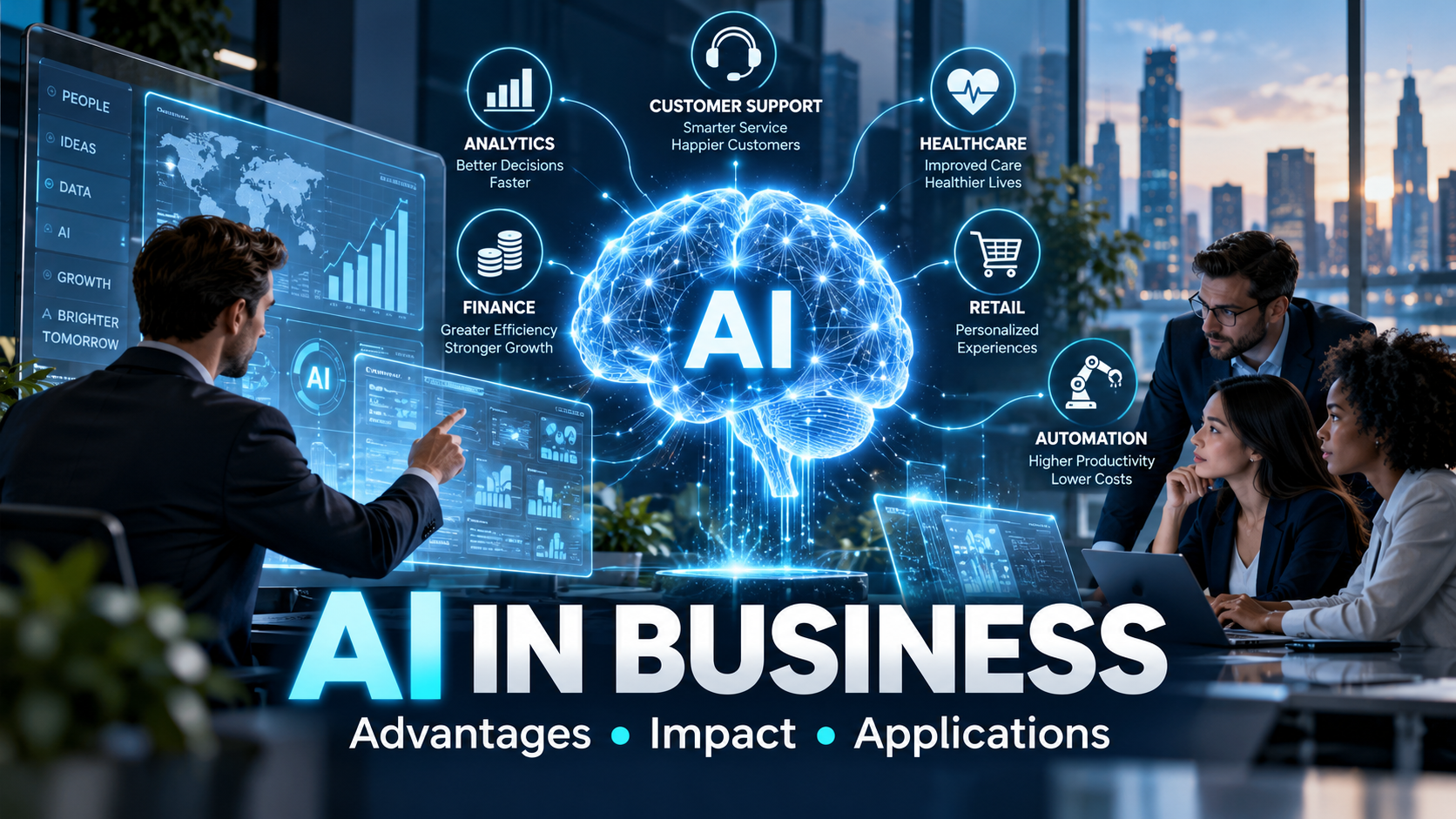
Imagine a small online business receiving hundreds of customer questions every week. Instead of manually answering every routine question, an AI-powered assistant helps customers find delivery information, while employees focus on complicated requests.
This is one example of how artificial intelligence is changing everyday business operations. From analyzing sales patterns to supporting medical research, AI can help organizations work more efficiently. However, it also introduces challenges involving accuracy, privacy, employment, and responsible decision-making.
Understanding the advantages of AI, its effects on society, and its major applications helps businesses identify opportunities without overlooking potential risks.
Artificial intelligence (AI) is a field of computer science focused on developing systems that perform tasks commonly associated with human intelligence. These tasks include recognizing patterns, understanding language, making predictions, solving problems, and generating content.
Unlike traditional software that follows only explicitly programmed instructions, many modern AI systems use machine learning to identify patterns from data. They can then apply those patterns to new information.
Consider an email spam filter. Rather than relying exclusively on a fixed list of blocked words, a machine-learning system can analyze characteristics of messages and estimate which ones are likely to be unwanted.
The process varies by AI technology, but many machine-learning applications follow three basic stages:
Relevant information is collected, cleaned, organized, and prepared for model training.
Algorithms learn relationships and patterns from training examples.
The trained system processes new inputs to make predictions, classify information, or generate responses.
Important distinction: Not every AI system learns in this way. Rule-based and symbolic AI systems can use explicitly defined knowledge and logical rules.
The main advantages of AI come from its ability to process information, assist with repetitive work, and identify useful patterns. These benefits can support organizations of different sizes, although results depend on the tools, available data, and implementation.
AI can help employees complete time-consuming activities such as categorizing documents, preparing summaries, and analyzing large datasets. This can create more time for tasks requiring human expertise.
Businesses can use AI to classify incoming requests, extract invoice information, and route routine cases to the correct department. Exception handling and quality checks may still require employees.
Machine-learning systems can identify relationships in sales, customer behavior, and operational data. For example, retailers may use demand forecasting to help plan inventory purchases.
AI can highlight trends, estimate possible outcomes, and support business planning. Managers should still assess model limitations and consider factors that may not appear in the data.
AI-powered assistants can answer common questions and help customers find information outside normal business hours. Sensitive, complex, or unresolved cases should have a clear human escalation path.
Online stores and digital platforms can recommend relevant products or content based on customer preferences and behavior, provided data is handled appropriately.
Computer vision can help detect visible defects in manufacturing processes. AI-based monitoring can also flag unusual activity for investigation, although false positives remain possible.
Well-designed AI workflows can help organizations handle larger volumes of requests or information without increasing every manual task at the same rate.
The AI impact extends beyond faster software and automated processes. Artificial intelligence is influencing how organizations operate, how people work, and how services are delivered.
In business, AI can support more efficient workflows, data analysis, and customer experiences. In healthcare, it can assist qualified professionals with certain diagnostic and administrative tasks. In education, it may help educators create learning materials and offer additional practice opportunities.
AI-powered accessibility tools, including speech recognition and automated captions, can also make digital information easier to use for people with different needs.
AI adoption can also change job responsibilities, create new skill requirements, and reduce demand for some routine tasks. Additional concerns include incorrect recommendations, privacy breaches, biased decisions, and the spread of misleading AI-generated content.
| Area | Potential Positive Impact | Potential Concern |
|---|---|---|
| Employment | New tools, skills, and job opportunities | Task displacement and retraining needs |
| Healthcare | Improved analysis and clinical support | Errors, patient privacy, and validation |
| Education | Personalized learning assistance | Inaccurate content and overreliance |
| Business | More efficient processes and insights | Implementation costs and operational risk |
| Information | Translation, search, and content assistance | Misinformation and fabricated content |
AI does not affect every profession in the same way. Some tasks may be automated, others may become easier, and new responsibilities may emerge around AI oversight, data quality, and system management. For many employers, employee training and thoughtful workflow redesign are as important as selecting the technology itself.
Artificial intelligence includes several overlapping disciplines. Understanding these AI fields helps explain why different AI systems can perform different tasks.
Machine learning uses data to train systems that recognize patterns and make predictions. Applications include fraud detection, recommendation engines, and demand forecasting.
Deep learning is a subset of machine learning that uses multilayer neural networks. It supports complex tasks involving images, speech, language, and other forms of data.
Natural language processing, or NLP, focuses on working with human language. Examples include translation, text classification, speech recognition, and conversational assistants.
Computer vision enables systems to analyze images and video. Common uses include industrial inspection, object detection, document scanning, and medical-image analysis support.
Robotics combines mechanical systems, sensors, and control technology. AI can help certain robots perceive their environment, plan movements, and adapt to changing conditions.
These systems represent knowledge through rules, facts, or logical relationships. They can support troubleshooting and structured decision-making in specialized domains.
Generative AI creates content such as text, images, code, and audio. It commonly uses deep-learning models and overlaps with language processing and computer vision.
Note: These categories are not mutually exclusive. For example, a generative AI application may use deep learning and natural language processing together.
AI fields describe the technologies and methods behind intelligent systems. AI applications describe how those technologies are used to address practical problems in different industries.
Businesses often combine multiple AI technologies to build complete solutions. The examples below show how AI can support different industries.
| Industry | AI Application | Potential Business Value |
|---|---|---|
| Healthcare | Medical-image analysis assistance, documentation support | Support for clinical workflows and review |
| Finance | Suspicious transaction detection, risk modeling | Faster identification of unusual patterns |
| Retail | Demand forecasting, product recommendations | Inventory planning and relevant recommendations |
| Manufacturing | Visual quality inspection, equipment monitoring | Earlier detection of defects and potential faults |
| Education | Learning assistance, content adaptation | Additional support for teachers and students |
| Transportation | Route planning, demand prediction, driver assistance | Better planning and operational support |
| Marketing | Audience analysis, content drafting, campaign insights | More efficient planning and content workflows |
| Customer Service | Chatbots, ticket classification, knowledge retrieval | Faster handling of routine inquiries |
AI systems can assist with image interpretation, medical documentation, and the analysis of complex data. These tools require appropriate testing, professional oversight, and safeguards for patient information. They are not substitutes for qualified clinical judgment.
Financial institutions use analytical models to identify unusual transactions, evaluate risk, and support customer operations. An automated warning can help an investigation, but a flagged transaction does not necessarily prove fraud.
Retail businesses can analyze purchasing patterns, suggest relevant products, and estimate inventory needs. Effective recommendations depend on data quality, appropriate privacy practices, and continued monitoring.
Manufacturers may use computer vision to inspect products and predictive models to identify signals associated with equipment problems. These systems can support maintenance planning and quality control when properly validated.
Artificial intelligence is not limited to large technology companies. Smaller organizations can explore targeted AI tools, while larger businesses may integrate AI into more complex operations.
Consider a fictional online retailer that receives 200 customer inquiries each week. After reviewing past requests, the team discovers that many questions concern delivery updates, return policies, and order status.
| Task | Manual Workflow | AI-Assisted Workflow |
|---|---|---|
| Routine questions | Employee types each response | Assistant retrieves approved information |
| Complex complaints | Employee investigates the issue | AI routes the case to a human employee |
| Performance review | Manual analysis of messages | AI groups trends for employee verification |
The retailer could test the assistant on a limited set of approved questions before expanding its use. It would monitor response accuracy, unresolved requests, customer satisfaction, and time spent reviewing AI outputs.
The value of AI is not simply answering more messages. It is handling suitable routine work while maintaining reliable service and providing human assistance when needed.
This is a hypothetical example, not a measured business case study.
Although AI has several benefits, it is not always accurate, affordable, or appropriate for every task. Businesses should evaluate technical and organizational risks before relying on AI-generated outputs.
Generative AI systems can produce convincing but incorrect answers, calculations, or references. Important outputs require verification.
Entering confidential information into an unsuitable AI service may expose sensitive business or personal data.
Models can reproduce unfair patterns in training data or perform differently across groups, especially in consequential decisions.
Subscription fees, integration, training, monitoring, and maintenance can reduce expected financial benefits.
Changing workflows may require new skills, employee support, retraining, and adjustments to job responsibilities.
AI systems can introduce security risks, while excessive reliance on their recommendations may weaken independent review.
Organizations should assess AI risks throughout the system’s lifecycle. The NIST AI Risk Management Framework and OECD AI Principles provide established guidance covering issues such as reliability, safety, transparency, accountability, and fairness.
Businesses do not need to automate every department to explore the value of AI. A small, measurable project is often a more practical starting point.
Choose a repetitive, measurable task, such as categorizing support tickets or preparing first drafts of internal reports.
Compare functionality, security controls, integration requirements, pricing, and the ability to review outputs.
Establish rules for what information employees can enter into AI tools. Review vendor data practices and relevant privacy obligations.
Test a limited workflow using representative examples. Check errors, exceptions, customer effects, and employee feedback.
Compare the new process with the existing one using accuracy, total processing time, cost per task, and customer satisfaction where relevant.
Provide employee training, establish clear accountability, and expand the use of AI only when evidence supports doing so.
Artificial intelligence continues to develop, creating opportunities for new tools and business processes. However, the future impact of AI will depend on technical progress, economic conditions, regulations, and how organizations choose to adopt it.
Assistants may support increasingly complex research, communication, and administrative workflows.
Systems that process combinations of text, images, audio, and video may expand practical use cases.
Organizations may combine AI with existing software to support more connected business processes.
Testing, oversight, transparency, and risk management will remain important as adoption expands.
Rather than assuming that every emerging AI capability will succeed, businesses should evaluate new applications against genuine operational needs and demonstrated performance.
Artificial intelligence offers useful opportunities for businesses and society, from improving productivity and analyzing information to supporting services across different industries.
Understanding the major AI fields, practical applications, and potential limitations makes it easier to evaluate where the technology can deliver meaningful value.
The most effective approach is to focus on real problems, test solutions carefully, protect sensitive information, and maintain appropriate human oversight. AI should support better decisions and workflows rather than replace critical thinking.
For deeper understanding, readers can consult the following established resources:
