Physical Address
304 North Cardinal St.
Dorchester Center, MA 02124
Physical Address
304 North Cardinal St.
Dorchester Center, MA 02124

Financial software must combine dependable transaction handling with clear user experiences and careful data controls. Banks and fintech providers are modernizing older systems while connecting new applications to payment networks, identity services and cloud infrastructure. Open banking and AI-assisted workflows add opportunities, but they also raise the importance of audit trails, system reliability and integration testing. The right engineering approach depends on how much regulatory and operational complexity the product carries.
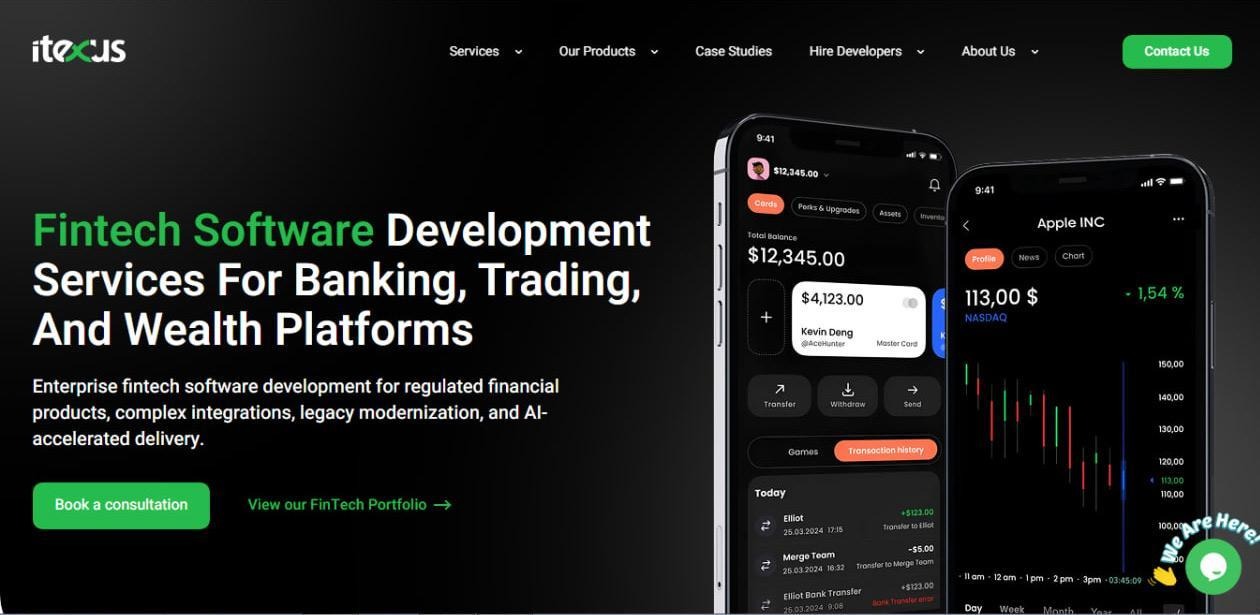
Itexus develops financial software for banks, lenders, investment firms and fintech product companies. Its delivery work spans digital banking, payment infrastructure, brokerage applications and wealth management platforms, with particular attention to complex integrations and regulated workflows. In one credit union project, automated onboarding reduced account opening from five days to 15 minutes. The company also built a digital wallet and payment ecosystem for Coinstar, linking customer applications to physical kiosks and financial services.
Gilzor develops and improves custom fintech web and mobile products, particularly applications with complex real-time workflows. On the KickEX cryptocurrency exchange app, the team reworked the Android architecture and socket handling while maintaining features for trading, wallets and withdrawals. Its published case study reports a 0.03% application error rate. Gilzor also handles product discovery, interface design, third-party identity checks and maintenance for finance applications that need more dependable releases.
A-listware provides software development teams for financial services organizations working on banking, investment, insurance and cryptocurrency systems. Its financial services offering covers web applications, mobile products and combined frontend-backend delivery. In a published banking engagement, the team describes reviewing an existing user interface and backend before rebuilding parts of the application in stages. This makes A-listware relevant to finance businesses extending internal engineering capacity or improving established software.
Mobian develops mobile-first financial products involving lending, payments and personal finance. For Girls First Finance in Kenya, the studio acted as a technology lead and built a platform with credit scoring and budgeting functions; it reports that the platform supported 700 education loans in 2024. Its broader engineering experience includes mobile wallets, NFC payments and corporate expense applications. Mobian offers complete project delivery as well as engineers who join an existing product team.
OSKI Solutions builds custom platforms and business systems, including finance-related portals and software used by insurance businesses. A published project for Alliant brought multiple insurance websites onto a shared architecture with controlled staff access. The company also develops integrations with accounting systems such as QuickBooks and provides cloud modernization for existing applications. Its senior-led engineering model suits finance teams that need tailored operational software or extensions to systems already in production.
net-devs provides senior-led engineering for financial applications where auditability and reliable transaction processing matter. Its fintech offering emphasizes traceable changes, encryption, access controls and explicit recovery behavior for payment systems. The team works on backend services, interfaces and the surrounding cloud infrastructure, supported by testing that covers failed transactions as well as successful ones. It is relevant to fintech operators modernizing transaction processing or adding development capacity to a regulated software environment.
SoftPro develops tailored business applications using the Microsoft ecosystem, with work spanning application modernization, web systems and cloud services. Its engineers build software around existing business processes rather than fixed product templates. For a financial services project, that work can include secure customer portals, internal dashboards and integration with established applications. SoftPro’s .NET and Azure capabilities are particularly relevant when an organization needs to evolve an operational system without replacing every component at once.
21century.tech uses an AI-assisted software delivery model in which senior engineers remain responsible for architecture, security decisions and code review. Its services include new applications, MVPs, integration work and refactoring of older systems. For fintech teams with defined product requirements, this approach supports the engineering of account-facing interfaces, internal workflow tools and integration layers. The studio also handles test coverage, deployment documentation and production handover as part of its development process.
Fintech software projects increasingly depend on the quality of the systems behind the interface. Secure identity checks, payment reconciliation and reliable connections to third-party services often require more engineering attention than a visible product feature suggests. Teams assessing development partners should examine relevant production work and understand who owns security, testing and post-launch support. For established financial institutions, phased modernization often matters more than replacing an entire system at once. Newer fintech products need an architecture that supports changing compliance requirements without making each release unnecessarily difficult.
