Physical Address
304 North Cardinal St.
Dorchester Center, MA 02124
Physical Address
304 North Cardinal St.
Dorchester Center, MA 02124
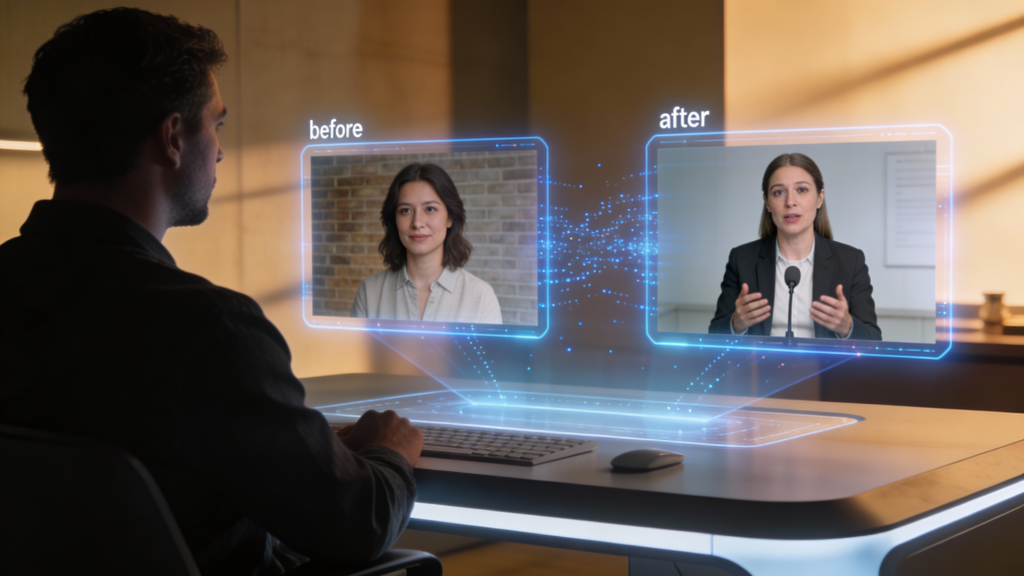
In 2026, the global content landscape is no longer just about “capturing” reality—it’s about synthesizing it. Two technologies, Face Swap AI and Lip Sync AI, have converged to fundamentally rewrite the rules of video and photo editing. What started as separate novelties—funny face filters and robotic text-to-speech—have evolved into a unified production powerhouse that is disrupting industries from Hollywood dubbing to influencer marketing.
This fusion has created a new standard: Total Identity Control. Creators can now manipulate who is in a video and what they are saying, seamlessly and at scale.
For years, Face Swap AI was primarily a visual tool. It allows you to replace one face with another in a photo or video, matching lighting and geometry with increasing precision. However, a swapped face in a video often felt disconnected because it couldn’t “speak” naturally; the mouth movements rarely aligned perfectly with new audio, especially if the dialogue was changed or translated.
Enter Lip Sync AI. This technology analyzes audio tracks—phoneme by phoneme—and regenerates the lip movements (visemes) of a speaker to match the sound perfectly.
When you combine these two, the magic happens. You can take a stock video of a model, swap their face to match your brand’s persona using AI Face Swap tools, and then use Lip Sync AI to make them deliver a completely new script in flawless French, Spanish, or Japanese. The result is a “virtual actor” who looks and sounds exactly how you need them to, without a single camera being turned on.
The most immediate impact of this convergence is in the dubbing industry. We’ve all seen old kung fu movies with laughable dubbing, where the lips keep moving long after the dialogue stops. That era is over.
In 2026, AI Video Dubbing has become a standard. Platforms now offer “visual translation.” When a YouTuber or Netflix series is dubbed into another language, Lip Sync AI modifies the actor’s actual mouth movements to match the new language. This increases viewer retention by 40-50% because the brain no longer perceives a disconnect between sight and sound.
For creators, this means a single video can now go global instantly. You can film an update in English, and within minutes, have five versions—German, Hindi, Mandarin, Portuguese, and Arabic—where you not only sound like a native speaker (thanks to voice cloning) but look like one too.
For individual creators and marketers, this technology unlocks a workflow called Asset Recycling.
This “remix culture” allows brands to A/B test dozens of variations. Does a male narrator work better than a female one? Does a younger avatar get more clicks? You can test it all without reshooting a single frame.
With great power comes the inevitable question of trust. As these tools become democratized—where anyone can make anyone say anything—the potential for misuse is real.
The industry is responding with a move toward Authenticated Media.
However, for creative expression, the benefits are undeniable. We are entering an era where the barrier to entry for high-end video production is near zero. You don’t need a lighting crew, a sound stage, or a casting director. You just need an idea, and the AI tools to weave the visual and auditory layers together.
In conclusion, Face Swap and Lip Sync AI are not just “editing features”—they are a new language of production. They allow us to break the constraints of physical recording and treat reality as a canvas that can be painted, spoken, and reimagined in infinite ways.