Physical Address
304 North Cardinal St.
Dorchester Center, MA 02124
Physical Address
304 North Cardinal St.
Dorchester Center, MA 02124

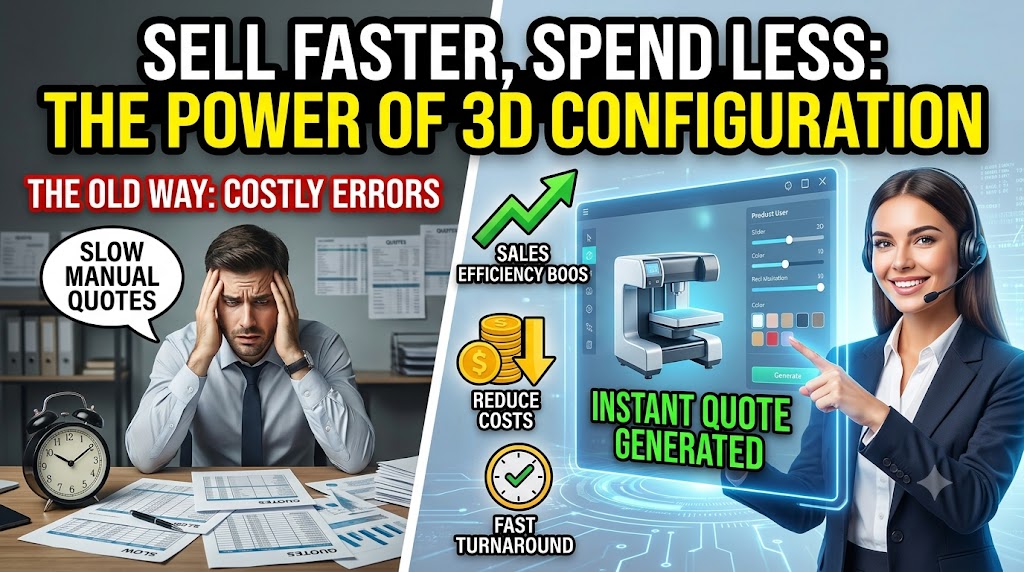
Imagine a customer ready to make a purchase—only to be told they’ll need to wait several days for a quote while sales teams verify specifications, calculate pricing, and confirm product compatibility. In today’s fast-paced market, delays like these don’t just frustrate customers—they can send them straight to a competitor.
Yet many businesses still rely on manual sales workflows involving spreadsheets, emails, and constant back-and-forth communication between sales, engineering, and production teams. These outdated processes slow response times, increase the likelihood of costly errors, and drive up operational expenses.
Digital configuration offers a smarter, more scalable solution. By combining interactive 3D visualization, intelligent configuration rules, and automated pricing, businesses can simplify complex sales processes, generate accurate quotes in minutes, and deliver the seamless buying experience modern customers expect.
In this article, we’ll explore how digital configuration improves sales efficiency, reduces operating costs, and helps businesses stay competitive in an increasingly digital marketplace.
What Is Digital Configuration?
Digital configuration is software that enables customers or sales representatives to customize products online using an interactive interface. Instead of choosing from a static catalog, users can select different sizes, colors, materials, finishes, and features while seeing the product update instantly in 3D.
Modern configuration platforms also include business rules that prevent incompatible product combinations and automatically calculate pricing based on selected options.
The result is a faster, more accurate buying experience for customers and a more efficient sales process for businesses.
As customer expectations continue to rise, more manufacturers and retailers are searching for the best 3D configurator to modernize their sales process. The right solution goes beyond attractive product visualization—it simplifies complex configurations, automates pricing, and streamlines communication between sales, engineering, and production teams.
An effective configurator should provide:
When evaluating available solutions, it’s important to understand how to choose the best 3D configurator based on your products, sales workflow, and business goals.
Many companies still depend on manual quotation processes that require multiple departments to complete a single order.
A typical workflow often looks like this:
While this approach works, it consumes valuable employee time and increases operational costs.
Some of the most common problems include:
As product customization becomes more common, these inefficiencies become increasingly expensive.
Customers no longer need to imagine what the finished product will look like.
Interactive 3D configurators allow buyers to customize products while instantly viewing every change. Whether they’re changing dimensions, finishes, or accessories, the product visualization updates in real time.
This shortens decision-making and gives customers greater confidence before purchasing.
Pricing is one of the biggest bottlenecks in traditional sales.
Digital configurators automatically calculate prices as customers modify product options, ensuring every quote follows predefined pricing rules.
Businesses researching 3D Lighting Configurator pricing often discover that the value extends far beyond software costs. Automated pricing significantly reduces manual work, speeds up quotation delivery, and minimizes pricing mistakes that can affect profitability.
Rather than spending hours preparing quotations, sales teams can generate professional quotes automatically once the customer completes a configuration.
This allows businesses to respond much faster while providing customers with accurate pricing immediately.
Faster responses often translate into higher conversion rates.
Sales representatives frequently spend time answering repetitive product questions and preparing similar quotations.
With digital configuration, customers can explore products independently while the software handles compatibility checks and pricing calculations.
This allows sales professionals to focus on relationship building, strategic accounts, and closing more deals.
Digital configuration improves efficiency across multiple departments—not just sales.
Manual product configuration often results in incompatible product combinations or missing components.
Digital configurators use predefined rules to prevent invalid selections before an order is submitted.
This reduces:
Even a small reduction in configuration mistakes can generate significant cost savings over time.
Engineering teams are often asked to review routine product configurations.
By embedding configuration logic into the software, many standard validations happen automatically.
Engineering resources can then focus on product development and innovation instead of repetitive approval tasks.
Interactive 3D visualization gives customers a clear understanding of exactly what they’re ordering.
When customers can see accurate product representations before purchasing, they’re less likely to contact support with specification questions or request order changes later.
Modern buyers prefer self-service purchasing experiences.
They want to:
Digital configuration makes this possible through a single intuitive interface.
The easier the buying process becomes, the more likely customers are to complete their purchases instead of abandoning them.
Digital transformation has become a necessity for businesses selling configurable products.
Companies that continue relying on manual sales processes often struggle with slower response times, increasing labor costs, and inconsistent customer experiences.
Digital configuration creates a scalable sales process capable of supporting business growth without requiring proportional increases in staffing.
As customer expectations continue evolving, businesses that invest in automation today will be better positioned for long-term success.
Digital configuration has become one of the most effective ways to improve sales efficiency while reducing operational costs.
By combining 3D visualization, automated pricing, intelligent configuration rules, and instant quote generation, businesses can eliminate repetitive manual work, reduce costly errors, and deliver a better customer experience.
A digital product configurator is software that enables customers and sales teams to customize products online by selecting different features such as size, color, materials, and accessories. Advanced configurators also provide real-time 3D visualization, automated pricing, and built-in validation rules to ensure accurate product configurations.
Yes. While the cost varies depending on features and integrations, businesses often see a strong return on investment through faster quote generation, fewer configuration errors, lower operational costs, and improved conversion rates. The long-term savings typically outweigh the initial software investment.
Digital configuration reduces costs by automating repetitive tasks, minimizing manual quote preparation, preventing invalid product configurations, reducing manufacturing errors, lowering customer support requests, and shortening the overall sales cycle.
Industries that offer customizable products benefit the most, including lighting, furniture, kitchen and bath, windows and doors, industrial equipment, manufacturing, and home improvement. Any business selling configurable products can improve efficiency with digital configuration.
Look for features such as real-time 3D visualization, automated pricing, product rule validation, quote generation, ERP and CRM integration, mobile compatibility, and scalability. Choosing a platform with these capabilities helps create a more efficient sales process while improving the customer experience.
